NEW YORK – Ancient Greece and its wine culture were featured in Ancient Origins (AO) on June 26. The taste for salty wine was also explored in the article.
“Not only was wine an important trade commodity that found lucrative opportunities around the world, but it also held a place in both religious and medical arenas,” AO reported, adding that “there was a festival known as the ‘feast of the wine’ and a cult of Dionysus, the Greek God of wine, fertility, and festivity, active in the earliest years of ancient Greece. Euripides, an ancient playwright, even wrote a play signifying the importance of Dionysus and his cult to Greek Culture.”
Hippocrates of Kos, the father of medicine was also mentioned in the article as he “considered wine an integral part of a healthy diet,” AO reported, noting that he also “used wine as a disinfectant on wounds and experimented with different wines to see which one would work best as a good base to mix [into] other drugs and medicines.” Hippocrates prescribed wine “to cure ailments such as diarrhea and pain during childbirth,” AO reported, adding that the ancient Greeks “also recognized that wine also had negative health effects especially when wine was consumed in excess.”
“Many contemporaries noted the ideal amount of wine to drink,” AO reported, noting that “it was suggested that three bowls or Kylix, the Greek drinking vessel, was the right amount to consume. This is still used today as a standard bottle of wine that has 3 glasses in it.”
Homer’s Odyssey also mentions wine “over ten times,” mostly for feasts and religious ceremonies, AO reported, adding that “men were expected to drink wine in moderation, and only when mixed and consumed with food.”
Dionysus is credited with inventing wine pressing, according to AO, which noted that “4th century BC writer Theophrastus, a successor to Aristotle, wrote of the study of vineyard soils and hoped to match them to specific grapevines,” and “left a detailed manuscript on yield rotation and harvesting of plant cuttings to ensure easier cultivation.”
“When the grapes were ready for crushing, wicker baskets were stored inside wooden or earthenware vats with a rope or plank placed above,” AO reported, adding that “the grapes were then crushed” by workers using their feet and “occasionally festively accompanied by music.”
The crushed grapes were then placed in “pithoi” large containers for fermentation, “similar to modern-day casks or drums,” AO reported, noting wine production innovations the Greeks introduced, including straw wine production in which the grapes dry out to become raisins before they are pressed, “creating a more acidic wine for blending.”
The Greeks also added various flavorings, including “resin, herbs, spices, brines, and oils,” AO reported, adding that “mulled wine and vermouth are some of the legacies of this practice.” Retsina is also still popular today and made with resin added.
“Drinking wine that was not mixed with water in Greek culture was considered barbaric,” AO reported, noting that “wine that had not been mixed should only be used as medicine or as a tonic when traveling.”
According to contemporary writings, wine was mixed with “50 parts must, freshly crushed grape juice containing skins and stems, with 1 part seawater,” AO reported, adding that “this was taught by Dionysus after he was threatened by the King of Thrace and hid in the sea.”
The saltwater mixed wine “was known as ‘wine that smells like flowers’ because of the smell that it produces when the must is mixed with seawater,” AO reported, noting that “particularly prominent on the island of Kos” wine mixed with seawater also helped preserve the wine for long voyages and “it was this wine that spread throughout the world.”
Also mentioned by Cato in his book on agriculture, “it is still used, albeit in a small amount, today to produce wines, AO reported, adding that “Thalassitis wine is still being produced and is made by submerging the grapes in seawater before they are crushed.”
June 29, 2021 at 06:11PM
https://ift.tt/3qD6mYe
Ancient Greeks and Their Taste for Salty Wine - The National Herald
Iowa may not be wine country, but that didn't stop the state from producing what one competition named the best sweet Rosé of the year in an international wine competition earlier this month.
Soldier Creek Winery, based in Fort Dodge, walked away from the "THE Rosé Competition 2021" with a Best of Show win for the sweet wine category for its "Paragon Pink" wine.
A Rosé blend vintage 2020, "Paragon Pink" can be picked up for $19 at the Winery in-person or shipped online. Judges said they were "thrilled by its balance of fruit, sweetness and complexity" at the competition, according a news release — and the makers note online that it has strong "grape and strawberry jelly flavors."
The competition was held at the Fort Lauderdale Woman’s Club, in Fort Lauderdale, Florida, on June 18. Hosted by the American Fine Wine Competition, the Rosé-exclusive event had judges test and compare more than 160 entries. Judges went into each wine-tasting blind, with no information about where or when the wine was produced.
That method "allows underdog wines from places like Iowa or Rhode Island to shine through, and even win," Judge Sunny Fraser said in the release.
Wine from other unlikely places won other categories in the competition, too: Judges gave the top award in the dry Rosé category to a wine from Newport Vineyard in Rhode Island. More conventional was the best sparkling wine winner: a Sangiovese Brut Rosé from Pope Valley Vineyards in Napa County, California.
Judges said they were happy to see wines from different parts of the country winning this year's competition.
"It's great to discover new Rosés coming from non-traditional winemaking states such as Rhode Island, Iowa and Idaho, amongst others," Judge Michael Goldberg said in the release.
Robin Opsahl covers trending news for the Register. Reach them at ropsahl@registermedia.com or 515-284-8051.
June 29, 2021 at 06:01PM
https://ift.tt/3y60Yzi
Fort Dodge winery wins 'best of show' among sweet Rosés in international competition - Des Moines Register
One fact proven throughout time is that Ozarkers love the outdoors.
All of the walking, cycling and driving trails in this region are a testament. Along with the outdoor activities, there is also outdoor dining. Whether in the backyard, on the deck or at the park, there is a certain joy from outdoor dining.
Now, to add elegance and opulence to an outdoor meal or get together, there’s nothing better than a sparkling wine.
Unfortunately, when one mentions sparkling wines, the name Champagne invariably comes up. Champagne is French, elegant and very costly. As a result of the higher cost, the wine is often reserved for special occasions and rarely served as part of a meal. Wine is a beverage that should accompany a meal, and that function also must include the sparkling wines.
Fortunately, there are other sparkling varieties that are of equal quality and enjoyment – and are considerably less costly than champagne. Among them are the sparkling wines of the Franciacorta region in Italy. The wines of Franciacorta are very popular in Europe because of their ability to meld with the nationality of practically any meal and will turn simple fare into a feast.
It is now time for sparkling wines to take their turn on the American dinner table.
Lantieri Extra Brut ($30) This wine, as are most sparkling wines of Franciacorta, is produced using the centuries-old traditional process of fermenting and carbonating the wine in the bottle it will be sold in, which is identical to the method used to produce the French Champagnes. The aroma of this wine is characteristic of all wines fermented in the bottle, hints of bread and yeast enriched with delicate notes of citrus and dried fruits, such as almond, hazelnut and dried figs. The flavors are savory, fresh and enjoyable, and it deserves a place on the dinner table.
Berlucchi 61 Rose ($45)
This Franciacorta rose has an intense pink color derived from the time spent on the skins of the pinot noir grapes used to make this wine prior to fermentation. The aroma presents notes of wild berries and ripe fruit, yeast and bread crust. The red berries with a hint of cherry continue on to the flavor and then to the finish. This wine can even turn tuna surprise, meatloaf or sloppy Joes into a gourmet feast.
Ca d’Or Noble Rose ($42) Beautiful bottle, beautiful pink color and a beautiful wine. The Ca d’Or sparkling rose captures all the great features of a pinot noir and chardonnay blend in a single sparkling wine. The true aromas and flavors of both varieties shine through and are amplified by the bubbles. This wine can accompany almost any food, and I found it to be a winner with Asian dishes.
Cortefusia Franciacorta Saten ($22)
“Saten” means silk and that word best describes the wine: silky. This pinot noir and chardonnay blend, the same blend that is used for many French Champagnes, can easily rival those costly wines and at a much lower price. The wine has been made as a white wine rather than a rose by not allowing the wine to have contact with the color forming skins. The result is a wine that more favors the chardonnay than the pinot noir by downplaying the red fruits and replacing them with smooth, luscious flavors of the chardonnay.
Cola Franciacorta Saten ($22) Get the term cola out of your head; the only thing that this wine has in common with soda pop is the bubbles. It’s one of the few vintage-dated sparkling wines from Franciacorta and going one step farther, it is 100% chardonnay. The Cola Franciacorta Saten has the softness, smoothness and elegance that only a totally chardonnay wine can have. This wine is the perfect accompaniment for hors d’oeuvre, seafood, Asian dishes and even with brats while watching the game (don’t knock it before you try it).
Wine columnist Bennet Bodenstein can be reached atfrojhe1@att.net.
June 29, 2021 at 06:23AM
https://ift.tt/3A6SBVP
Wine Review: Get outdoors with sparkling wine, food pairings - Springfield Business Journal
Vintage Wine Estates has acquired The Sommelier Co., which provides private and virtual wine and spirits tastings.
The Santa Rosa-based wine company said that The Sommelier Co. will help boost its direct-to-consumer business that already represents 30% of its income. The deal was announced Tuesday and is the first one since Vintage Wine Estates became a publicly traded company on June 8.
The Huntington Beach company — which conducts such tastings with certified sommeliers — had net revenue of more than $5 million last year as virtual tastings took off during the pandemic.
“We are thrilled to be able to offer the services of The Sommelier Co. to our direct and business consumers and look forward to expanding the opportunities to present our portfolio of wines to a highly qualified and wine-enthusiastic customer base,” said Jessica Kogan, chief marketing officer for Vintage Wine Estates.
New tasting complex opens in Healdsburg
A new collective tasting complex will open in Healdsburg next month.
Bacchus Landing will be the home to at least seven wineries across five separate open-air tasting rooms. It is just north of Westside Road and east of Dry Creek.
The project is founded by Sonoma County residents Monica and Francisco Lopez along with their parents Al and Dina. The Lopez family also operates Aldina Vineyards, which focuses on premium cabernet sauvignon from Sonoma County. Other wineries include Montagne Russe Wines as well as 13th & Third Wines. Both AldenAlli and Dot Wine will come into the place later this year. Two others will be announced at a later date.
“Over the past 18 months, we have watched the evolution of the Lopez family dream turn into a reality, and we’re honored to have them as strategic partners. The location, design, and energy behind this project fits perfectly with our passion for hospitality,” says Dan Kosta, co-founder of AldenAlli, in a statement. Kosta was a co-founder of Kosta Browne winery in Sebastopol, which he later sold.
Grape growers to hold in-person event
The Sonoma County Winegrowers trade group will hold its annual grower seminar on July 15. The group represents local wine grape growers in the county.
The event will feature a virtual seminar from 8 a.m. to 9:30 a.m. and later an in-person trade show and barbecue at the Luther Burbank Center from 10 a.m. to 12:30 p.m., which will be the first live event for the trade group since the onset of the coronavirus.
More information on the event can be found at bit.ly/3gWzPZP
June 26, 2021 at 08:07AM
https://ift.tt/3h04SDW
Vintage Wine Estates buys tasting events company - North Bay Business Journal
TURNER, Ore. — Willamette Valley Vineyards is building a new winery in the Dundee Hills southwest of Portland and will hire a new director to oversee winemaking and vineyards, including 65 full- and part-time employees, the company announced on June 24.
Jim Bernau, founder and CEO, said the decision comes as production has vastly outpaced capacity at the current winery in the Salem Hills near Turner, Ore.
"It got to the point where I just couldn't wait any longer," Bernau said. "We have exceeded the design capabilities for this winery."
Founded in 1983, Willamette Valley Vineyards is a leading producer of Oregon Pinot noir. The winery was originally built for making 12,500 cases of wine per year, Bernau said.
Last year, the winery produced 175,357 cases — more than 14 times its initial capacity.
"That creates a lot of pressure on our cellar staff," Bernau said. "What I really need to do is prepare for the future."
Four years ago, the company purchased 40 acres in the Dundee Hills American Viticultural Area along Highway 99 where it plans to build a state-of-the-art winery with the capacity to produce between 250,000 and 500,000 cases annually.
The winery will be within a few miles of Willamette Valley Vineyards' new sparkling wine facility, called Domaine Willamette, which is slated to open in May 2022.
Bernau said the sparkling winery and tasting room is a "considerable investment," with the building and road improvements exceeding $15 million. The site is already home to a mature vineyard, and will also feature a biodynamic garden.
Growth for Willamette Valley Vineyards doesn't stop there. The company is building four winery restaurants, with the first to open before the end of the year in Lake Oswego, Ore. Three others are planned for Vancouver, Wash., and Bend and Happy Valley, Ore.
Along with increasing brand awareness nationally for Oregon Pinot noir, Bernau said the restaurants will only add further demand. He estimates that Willamette Valley Vineyards will need to double production over the next 5-7 years to keep pace.
The company has hired Steven Martin Associates, an engineering firm based in Sonoma County, Calif., to come up with designs for the new winery. There is no timetable or cost estimate yet for the project.
"We're going to move as quickly as we can," Bernau said.
The Salem Hills winery will still be used to make small lots of Pinot noir, with more of the space to be dedicated to wine tastings and hospitality, Bernau said.
In addition, Willamette Valley Vineyards is creating a new position, director of winemaking and vineyards, who will help manage the transition into the new winery while overseeing operations and assisting in the development of brands and products.
Willamette Valley Vineyards owns five vineyards in the Willamette Valley, totaling about 500 mature acres, as well as 35 acres in Eastern Oregon and Washington in the Walla Walla Valley and The Rocks District of Milton-Freewater AVA. The winery also has 500 acres under contract with Oregon growers.
Bernau credits expansion of the winery to its business model, as a publicly traded company with more than 19,000 wine enthusiasts as shareholders.
In mid-June, the winery issued a $10.7 million stock offering to fund the new restaurants. Shares are being sold at $5.05 with a 4.36% annual dividend, or wine credit worth 15% more.
"The foundation of our success is our owners," Bernau said.
According to its latest annual report filed with the U.S. Securities and Exchange Commission, Willamette Valley Vineyards managed to increase sales and income, despite the pandemic. Net sales were $27.3 million, up approximately 10% over 2019, while net income was $6.9 million, a 23% increase.
June 29, 2021 at 01:15AM
https://ift.tt/3hw4tbJ
Willamette Valley Vineyards to build new winery | Orchards, Nuts & Vines | capitalpress.com - Capital Press
Each product we feature has been independently selected and reviewed by our editorial team. If you make a purchase using the links included, we may earn commission.
An ice-cold glass of crisp wine can make even the hottest days more bearable. The thing is, ice melts. When it does, you're left with a glass that's half wine and half water, and nobody wants that. While looking for a better way to chill wine this summer, we enlisted the help of La Crema Winery head chef Tracey Shepos, who shared a genius solution to keeping wine cool and flavorful at the same time. I'll be taking her advice all summer long, and here's why you should, too.
La Crema Winery has been making Burgundian-style chardonnay and pinot noir in Sonoma county, California for over 40 years. The brand focuses on growing grapes in small lots that foster bold, distinct, and balanced flavors in every bottle. With flavors so deliberate, it would be a shame to waste a drop. That's why Chef Tracey recommends freezing your leftover wine into ice cubes. When you're ready to pour a glass (I suggest the 2019 La Crema Monterey Rosé), instead of adding regular ice cubes, pop in a few cubes of pre-frozen wine instead.
"Traditional water ice cubes water down the wine, diluting the flavor. I want my wine to taste full, vibrant, and flavorful until the last sip," Shepos tells Food & Wine. Who could argue with that? Freezing leftover wine into ice cubes is the perfect way to preserve those last few sips of a bottle while ensuring each future glass remains boldly flavored. While you're at it, frozen wine cubes can be used in a variety of culinary projects, Shepos adds. Looking to quickly punch up a sad pan sauce? Add a cube or two of La Crema Sonoma Coast Chardonnay. It's a simple way to keep little blocks of flavor on hand whenever you need them.
Here's the most important detail: Remember to label your ice trays so you know exactly what you're adding to your glass each time. Nobody wants to mix chardonnay and sauvignon blanc, so having designated ice trays for each varietal is a guaranteed way to make sure you know what you're drinking.
If you love ice cold wine, consider trying this expert-approved hack to ensure you'll have chilled, full-flavored wine to get you through the hottest days of summer. To help you get started, we've rounded up five of the best ice trays on Amazon for freezing wine-all under $10-below.
These BPA-free silicone ice trays have a removable lid that makes storing and freezing liquids completely mess-free. The clear lids are also easy to label, so you can be sure you know what you're adding to your wine. For even more clarity, designate each color tray for a certain varietal. That way, when you grab the pink ice tray, you know you're grabbing rosé.
To buy: Easy Release Silicone Ice Cube Tray, $8 (originally $9) at amazon.com
The smaller cube size in this two-pack are ideal if you'd like to add a little chill to your wine without overloading the glass with too much ice. Plus, the food-grade silicone makes for easy release.
To buy: Silicone Ice Cube Tray with Lids, $4 at amazon.com
A plastic base makes these ice trays durable, strong, and easy to stack, so if you have lots of leftover wine on hand, consider grabbing a four-pack for just $10. Thanks to the white lining, labeling with a permanent marker is super easy, too.
To buy: Stackable Silicone Ice Cube Tray with Lid, $10 at amazon.com
A giant ice cube lasts longer than a standard one does, so these large cubes will keep your wine nice and cool for hours. Not to mention, when your ice cube is made with wine, it'll act as a built-in refill as it melts.
To buy: Giant Silicone Ice Cube Tray, $8 at amazon.com
If you prefer crushed ice, these mini ice cube trays come pretty close to achieving the same texture and size. The two bendable silicone trays will even produce ice small enough to fit inside a water bottle or reusable wine bottle for your next boozy adventure.
June 29, 2021 at 03:43AM
https://ift.tt/2TgobzV
The Best Way to Chill Wine Fast, According to an Expert - Food & Wine
Lisa Howard grew up on a farm in the Suisun Valley in Fairfield, but her passion was math. In the summer she would pester he mom to put together math worksheets.
“But when people would ask me, ‘What do you want to be when you grow up?’ they never asked me, ‘Would you like to be an engineer?’ or ‘Would you want to be an architect?’ she recalled. “They said, ‘Oh, maybe one day, Lisa, you’ll be a teacher.’ Like they knew I liked math, but the closest thing they could get to that was a math teacher. Or a nurse, never the doctor.”
But in high school, Howard already knew that she wanted to attend Cal Poly San Luis Obispo and study agricultural engineering. She got that degree and landed a job as an engineer in Arizona to build irrigation systems.
In Arizona, she met her husband, Cliff, a Phoenix police detective, who convinced her to return to her roots in the Suisun Valley. They did so in 2014 and are now co-owners of Tolenas Vineyards and Winery at 4185 Chadbourne Road in Fairfield. Lisa still uses her engineering knowledge in growing grapes. And she encourages other women to follow in her footsteps.
“For me, it’s really important to make sure that young girls are exposed to all the different career options that they can do and not pigeonhole them into something just because they are a girl,” she said.
The Tolenas Vineyard and Winery features several varieties of wines including the Eclipse White Pino Noir (left) that earned Lisa Howard a gold medal at the 2019 International Women’s Wine Competition and a Suisun Valley Red that they call “the Swiss Army knife of red wines” that is made from five varieties of grapes.(Joel Rosenbaum — The Reporter)
She understands the challenges.
“There are starting to be more programs to accept women into college and into these certain careers,” she said. “But then, when they want to be in charge and run the business, that’s another hurdle. I would show up to a project management meeting, and other engineers would say, ‘Okay, we can start this meeting whenever the engineer is here.’ And I would say, ‘Um, that’s me. I’m here.'”
She said the biggest challenge for herself and other women is balancing a business with home life.
“I think a lot of women are scared to start their own business, especially if it’s not a home-based business, because a lot of us still want to be moms and we want to have a family,” she noted. “And you have to find a partner or a husband that is willing to help you at home and take on different roles than maybe they normally would… My husband is very supportive and willing to do anything. But you are still mom and your kids still want you and if you are out running a big business and it’s turning into something very demanding of your time, that balance is challenging.”
The Howards have three children, Jake, age 8, Amy, 6, and Katie, 4. Like Lisa with her parents, they are learning farm life hands-on.
“They have to be part of this life. Otherwise, it doesn’t work for us,” said Lisa. “They are part of what we do, all of the time. Katie was born right in the middle of harvest. And she lived in a backpack, I had my little pouch or she would be sleeping in a little carrier.”
Katie Howard, 6, (left) and her brother, Jake, 8, grew up in the family business of winemaking. Katie was born right in the middle of the grape harvest.(Joel Rosenbaum — The Reporter)
Lisa’s parents, Steve and Linda Tenbrink, are first-generation farmers.
“We watched them as children create this business from scratch, acquiring property slowly and working their butts off,” said Lisa. “I didn’t know what it was like to grow up in town or have neighbors’ kids close by. As I got older and had to start being more and more part of the business, the more I realized that it was probably a little bit too hard of a life for me to want to be part of as an adult. So I made a promise to myself that I wouldn’t be part of the farming life and that I would get a really good job that paid a lot of money and had benefits and health care and all of that good stuff.”
That’s just what she did, landing that well-paying job in Arizona. But Cliff, who she married in 2011, knew where her heart was.
“Cliff has always been talented in the real estate market. He’s always watched it very carefully. He said, ‘I really think that if we ever want to move back to Suisun Valley we need to do this now. The market is going to go up and if we don’t move now I will just be on the path to becoming a career police officer and we will have more children and we won’t want to move them in high school, so let’s move back.'”
“My initial reaction was, ‘You’re crazy. We have such a good life here. Why would we want to leave?’ And he said, ‘Yeah, but I just see it in you that Suisun Valley is in your heart and farming is in your heart and you want to carry on your family’s legacy and I just really have a sense that we should be back there.’”
Lisa reluctantly agreed, even though she had many tearful nights, thinking, “What are we doing? What are we giving up?” She admitted that she still had doubts after the move.
“I kept telling Cliff, ‘What did you do to us? This is horrible!'” she said. “But he was right. And honestly, if we had even waited another month on pulling the trigger on moving we wouldn’t have been able to afford the beautiful property that we were able to buy.”
They bought that 55-acre property in the northernmost section of the Suisun Valley in 2014 and attempted to farm the existing crops — grapes, prunes, pears and walnuts. But after two years, they realized it wasn’t enough to keep them afloat financially.
Pinot noir grapes ripen on the vine at the Tolenas Vineyards and Winery in Fairfield. The winery’s owner, Lisa Howard grew up in Suisun Valley and attended Cal Poly San Luis Obispo to study trained to be an engineer, and worked as an engineer in Arizona that builds irrigation systems before moving home and learning who to make wine.(Joel Rosenbaum — The Reporter)
“When we were trying to decide what we were going to do with this property, how we were going to pay this mortgage, Chuck Wagner of Caymus Winery came into Suisun Valley and was showing interest in the area,” said Lisa. “My sister worked for the Napa Jet Center at the time and Chuck tends to fly in and out of there and we said, ‘Gosh, how are we going to get his attention? How can we get him to come out and talk to us about leasing our property?’ Cliff wrote up a letter and my sister snuck it on the airplane on his seat on one of his flights. And he picked up the letter and the next time we saw Chuck, he said, “Oh, I know who you are!’ And we were able to secure a lease.”
So Caymus ripped out the existing crops, planted the new vineyard and made a deal with the Howards to buy back some grapes but also allow the couple to harvest some of their own grapes.
Another connection helped the Howards secure the building they use as the winery. Lisa knew Bob Hansen, who managed a building next door to the Suisun Valley Fruit Growers cooperative off of Rockville Road. She would go with her dad to pick up supplies there when she was a little girl.
“And so when we were interested in the property,” said Lisa, “I wrote him a letter that said, I know that there are a lot of other people interested in your property. But I vow to keep it in agriculture and to keep the legacy of Suisun Valley going and to make him proud that he was giving an opportunity to somebody who grew up here and not just somebody with millions of dollars.”
Hansen sold them the property which now houses their winery.
Lisa noted that she learned the old-school method of making wine from her parents, but her parents learned it from Abe Schoener, the assistant winemaker at Luna Vineyards in Napa. At a farmers ‘ market, he met Lisa’s mom, Linda, where Lisa had a sign that said, “Wine grapes for sale.” Schoener asked skeptically, “Are you really trying to sell wine grapes in Napa while you’re selling fruit in a farmers market?”
According to Lisa, her mom looked him straight in the eye and said, “Well, you think that my husband’s peaches and vegetables and tomatoes are the best things that you’ve tasted in your life. What makes you think that he can’t grow the best wine grapes?” So Schoener took a look at the Tenbrinks’ property and asked them to build him a winery that he would rent from them. He bought the grapes from them and also taught them how to make wine.
“And so my dad would make wine every year,” said Lisa. “And whenever I would come home to visit, especially if it were during harvest, I would pop in there and it would definitely light something up inside of me.”
That light burned until Lisa decided to move back home, where her parents taught her and Cliff the art of winemaking.
Katie Howard, 6 of Fairfield examines a bunch of pinot noir grapes at her parents’ vineyard and has grown up in the family business of winemaking. She was even born right in the middle of the grape harvest.(Joel Rosenbaum — The Reporter)
“We really are very low intervention,” said Lisa of their approach to making wine. “So for a lot of our red wines we used native yeast, native fermentation. Sometimes they call that spontaneous fermentation. It’s risky. When you innoculate with a commercial yeast, you have that one yeast that does all of the work from beginning to end. With native yeast it’s not one species, it’s all these different ones that do these different jobs at different times. So when it’s cold there is yeast that is working. As it starts to warm up and the alcohol gets higher, a different yeast takes over and it’s this whole population of lots of different yeasts, which allows for a more complex flavor. It has more dimension to it.
“And we are very gentle in our winemaking. We really don’t have a lot of automation, a lot of fancy equipment. It’s very hands-on, very old school. But I’m still an engineer by trade and I love technology and I love science and I love improvement so I’m always trying to bring in a little twist on that, kind of old school meets new school kind of mentality.”
The Howards won a gold medal at the 2019 International Women’s Wine Competition for their white pinot noir. Lisa said that hit them with the realization that “this is real, this is really a business. We are really doing this, and all of this hard work that we are pumping into this is going to pay off and to just keep going.”
She now has no regrets that she returned home to work the land.
“Our hearts will always be about agriculture,” she said. “Sometimes in the wine world and winemaking and winetasting, people forget that it really is an agricultural product. And that’s where our hearts are.”
OROVILLE — This weekend saw the return of the North Sierra Wine Trail after a 2020 pause in operations.
Ticket holders were able to visit 11 wineries that span from Oroville to Bangor, continuing to Dobbins/Oregon House and finishing in Sutter Buttes.
Tickets to the two-day event were $30. Included in the purchase was full access to all wineries included in the trail, a map displaying the locations of wineries, and a commemorative wine glass.
The trail took guests through a variety of microclimates, beginning at LIVE VINE Vineyard & Winery — a winery in Oroville that overlooks the Thermalito Afterbay.
Owners of LIVE VINE Vineyard & Winery, Shawn and Susan Smith, said that the trail was something they had been looking forward to returning after the year long absence.
In the break between the 2019 and 2021 wine trails, LIVE VINE has quickly grown. Now as the North Sierra Wine Trail returns for a new year, LIVE VINE is in the process of building a new facility to house an expanded tasting room overlooking the water.
Having participated in the North Sierra Wine Trail since it began, Grey Fox Vineyards said this was a quieter year with the heat. (Riley Blake -- Enterprise-Record)
Mike Beck Sr. performs live music at the Long Creek Winery and Ranch on Sunday. (Riley Blake -- Enterprise-Record)
Grey Fox Vineyards serves participants in the North Sierra Wine Trail on Sunday. (Riley Blake -- Enterprise-Record)
Wine grapes growing on the LIVE VINE Vineyard & Winery property. (Riley Blake -- Enterprise-Record)
A bottle of Grey Fox Vineyards Cabernet Franc. (Riley Blake -- Enterprise-Record)
The third stop on the wine trail was the 27 acre Long Creek Winery and Ranch, founded in 2001 by Lou and Yola Cecchi and now operated by the Phulps family. The winery is located at 323 Ward Blvd. in Oroville.
Owner Mike Phulps said taking over the winery four years ago came with a learning curve, coming into it — “not knowing anything about agriculture or the wine industry.”
Now Phulps said the learning curve has long passed, as he looks forward to the weekends when the winery tasting room opens up.
“We enjoy it,” Phulps said of the North Sierra Wine Trail. “We enjoy being a part of the trail and enjoy the experience of sharing our wines and our foods. It’s something we look forward to every year now.”
Phulps noted that for being a “boutique winery,” events like the North Sierra Wine Trail are a fun occasion, offering a new way for people to experience a variety of wineries throughout the region.
“Every winery you go to has something different. We’re kind of rural out here and you can’t see it from the street and we have a beautiful pond and a creek through the property.,” Phulps said. “We have a beautiful pond and a creek through the property.”
Phulps remarked that despite being in the winery business, there’s no competition in his eyes.
“In the winery business, you don’t talk bad about the other wineries. We support all the other wineries. We keep a map behind the counter if we get someone from out of the area and we encourage them to go see all the other wineries,” Phulps said. “Obviously, we’d like for you to buy a bottle of wine but it’s not necessary to buy a bottle of wine.”
Grey Fox Vineyards, founded in 1996 by the Arrigoni and Cecchi families, was the fourth stop along the wine trail. Located at 90 Grey Fox Ln., owner Jeanne Cecchi said that their winery has participated in all North Sierra Wine Trails since it began.
“We’ve been doing the (wine trail) ever since it started,” said owner Jeanne Cecchi. “It’s kind of a tradition with the only reason we didn’t have it last year being coronavirus.”
As for the 100-plus degree weather, Cecchi said that the trail usually takes place in April when temperatures are lower and because of that, the wine trail has seen fewer visitors this year. But the winery is taking this in stride, offering them more time to get to know the folks that visit compared to busier years.
“It’s going to take some time. People are still coming out and some aren’t used to going out again yet but we’ll get back to normal,” Cecchi said.
Despite the hot weather, it didn’t stop Linda Ginter and 6 of her friends from showing up.
“We like getting together and doing activities all through Oroville,” Ginter said. “We love our community and we want to support it. We’re just 7 ladies out to have a good time and support our community.”
Ginter and her friends who participated in both days of the wine trail made sure to have a designated driver as well.
“We’ve got a designated driver. He’s waiting for us in a van,” Ginter said. “He’s just waiting for us winos.”
The other wine producers along the North Sierra Wine Trail were Munger Family Vineyard, Sicilia Vineyards, Cordi Winery, Purple Line Urban Winery, Spencer Shirey Winery, Renaissance Vineyards and Winery, Lucero Vineyards and Winery, Hickman Family Vineyards, Grant-Marie Winery, and Bangor Ranch Vineyards and Winery.
June 28, 2021 at 06:01PM
https://ift.tt/2UNuKdJ
North Sierra Wine Trail returns after a year off - Chico Enterprise-Record
With the meteoric rise of meme stocks, markets flirting with record highs daily, and valuations vaulted at multiples never before seen, seemingly everyone wants a piece of the investment action these days. Conscious of this inrush, savvy investors are increasingly seeking less traditional asset classes to put their money into, and the diversification strategies to do so are progressively becoming more unique.
It is estimated that $70 trillion of wealth will be transferred from baby boomers to Millennials and Gen Z in the next 25 years, which means a younger generation of people with a lot of money to invest in things they care about. And the ability to make profitable investments based on passionate desires, be they altruistic (socially responsible investing) or egoistic (chasing returns with a fear of missing out mentality), is a motivating factor leading many newly minted investors to evaluate alternative strategies. Whether looking for endeavors that contribute to equitable social evolution or a hedge against inevitable corrections to traditional financial markets, investors are flocking to a host of non-traditional, tangible commodities.
Which is where fine wines and brown spirits come in. While in the past investors have shied away from alternative assets, like coins and antiques, due to fears of illiquidity and opaque valuations, the emergence of wine and whiskey investment portfolios — and really the sheer variety of fractional, democratized investment opportunities created in the last few years — underlies a greater shift to financialize pretty much everything, and signifies a newly defined approach to investing. But are they really the safer bet?
Wine Portfolios Take Liquidity to Another Level
Fine wine is an area that has witnessed significant growth recently, and the sector is poised to break out, as a number of firms and investment gurus, after eyeing several years of compelling returns, are expanding their holdings.
London-based Liv-ex promotes itself as the global marketplace for wine. The firm produces reports detailing market movers and valuations, documenting record growth in sales volume and value in the past year. With the renewed interest in wine collecting and investing spurred by the pandemic, certain varieties and vintages have seen values skyrocket. Not surprisingly, Champagne and Burgundy remain two of the most sought after and best-selling in the investment sphere. And the most traded fine wines of the last year, according to Liv-ex, included Lafite Rothschild, Petrus, Screaming Eagle, Mouton Rothschild, Sassicaia, and Taittinger.
In a 2020 article suggesting that investing in wine was essentially a way to ‘Covid-proof’ a portfolio, Forbes reported that $100 invested in wine in 1952 would be worth $420,000 today, while the same amount placed in the stock market would equate to $100,000. The numbers are impressive, but the claim begs the question of whether storage costs were taken into account, and these returns are likely based on assumptions that the proper labels and vintages were purchased.
Wine investment firms like Vinovest are well aware of the issues at hand when it comes to managing fine wine portfolios. The company, founded in 2019, handles all acquisition and sales responsibilities, storage, insurance, and portfolio management for a 2.85 percent annual fee, a number that drops to 2.5 percent with a $50,000 commitment.
Like other apps aiming to simplify investing, Vinovest offers access to the wine investing world through algorithmic mechanisms that take into account a client’s risk aversion and market fluctuations to identify strong investment portfolio strategies. The company is working to release a wine value index tool, comparable to the S&P, which offers live valuation indices.
When asked about the motivating factors drawing investors into asset classes such as fine wine, Vinovest co-founder and CEO Anthony Zhang says that three issues are driving interest: “diversification and low correlation during downturns” combined with “double-digit annualized returns over the past couple decades” and younger generations’ commitment to investing in ideas and products that they are passionate about.
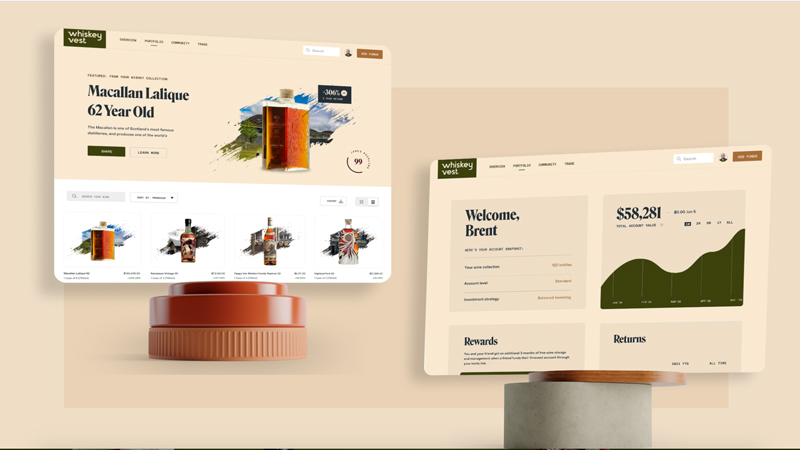
Credit: Whiskeyvest
The Returns on Rare Whiskey
After striking liquid gold with Vinovest, the team recently turned to another liquid venture, Whiskeyvest. Currently accepting members by invitation only, the company promises to “make investing in rare whiskey simple and accessible.” Focusing on exclusive bottles, Whiskeyvest highlights The Macallan’s 62-year-old single-malt Scotch — and its recent 143 percent appreciation — on its landing page.
Investing in whiskey and Scotch is a hot topic, and while the opportunity was traditionally only available to distillers and producers, investment groups are now purchasing casks, aging them in distillers’ bonded warehouses, and selling shares to the public. Scotch whisky investment firm WhiskyInvestDirect reports that Scotch has realized annual returns of 15.4 percent annually over the past decade.
Rare Whisky 101, the Scotch industry leader in valuation tools, compiled data covering 64,201 bottles and 727,268 transactions since 2003. The statistics indicate that Scotch has consistently outperformed the S&P.
As the industry is in its infancy, a multitude of variables are at play when it comes to investing in rare whiskey. Producers are now limiting production and creating ultra-rare vintages in an attempt to capitalize on trends. How this affects the market in the future remains to be seen. With supply and demand lying at the heart of all financial transactions, the advantage of the product being consumable is a significant factor that is difficult to project.
Everything’s an Investment, Almost
As with wine and whiskey, those who emerged from the past year flush with cash are pouring excess reserves into a variety of innovative investment opportunities. Real estate, typically a safe haven for wealth, is on fire in terms of popularity and capital in-flight right now, and other assets including art, watches, handbags, jewelry, and luxury goods are appreciating handsomely with renewed financialization schemes.
Luxury handbags are the only sector to record better returns than fine wine last year (up 17 percent), according to the Knight Frank Luxury Index. Hermès handbags, specifically, are a status symbol, and some models qualify as the most difficult consumer products to acquire, with extremely limited production. Demand far outpaces supply, and second-hand bags routinely sell for substantial markups. Baghunter documented a 500 percent increase over 35 years, with annual returns averaging 14.2 percent. Startup RSE Archives, doing business as Rally Road, identified the unique position held by luxury handbags and is now offering investors the option of purchasing shares in crocodile skin Birkins. The firm is not new to the investment game and has been allowing clients to invest in rare cars and baseball cards in a similar fashion.
Fine art has long been considered a strong capital asset, but the recent trend toward increased financialization in the art world offers even more diversification strategies for creative portfolio managers. New York-based Masterworks developed an organized art market where investors purchase shares in blue-chip masterpieces. The company buys works of renowned artists, securitizes the pieces with the Security and Exchange Commission, and then sells shares to interested buyers. Investors have the option of holding for three to 10 years until the firm resells the appreciated item and profits are split, or shares can be traded freely on the secondary market.
Watches are a favorite option for high-rolling investors. The luxury watch market is highly speculative, but collectors typically believe value exists in classic lines such as Patek Philippe’s Calatrava and the Day-Date President Rolex. Rocker John Mayer has a world-class collection, and his whims influence the market in a similar fashion to how Elon Musk’s musings impact the cryptocurrency universe.
Speaking of cryptocurrencies, their explosion is shifting the foundations of financial markets. Uncertainty abounds, and the soon-to-be-announced Federal Reserve version is expected to upset current prices by drawing institutional capital to a more centralized crypto model, but to what extent is anyone’s guess.
Lastly, non-fungible tokens, or NFTs, have taken on a life of their own, with a host of companies, including BitWine, betting on the newly found market by combining digital art with iconic wines.
What Goes Up Must Come Down
While bubbles are lovely in Champagne, they tend to be quite dangerous in financial markets. Though the ride to the top feels good, and nobody ever likes to believe that it’s about to be over, the past 15 months have been a genuine rollercoaster testing the credulity of investors and the credibility of the markets as a whole.
From today’s perspective, with markets soaring and businesses reopening, it is easy to forget how dire the situation was financially last year, and how incompatible the current fiscal situation is in relation to common sense. (As reported by Current Market Valuation, the current price-to-earnings ratio is 37.1, a number that suggests the stock market is strongly overvalued, with the ratio measuring the stock price relative to gross revenues 89 percent higher than normal and 2.3 standards of deviation above average.)
Illogical valuations are being fueled by unprecedented capital injections meant to stymie pandemic-related losses and disruptions. The market crash that occurred in March 2020 spooked investors, routed 401ks, and created a crisis that allowed for fiscal policies that would have raised serious red flags in any normal situation. While the numbers don’t lie, an important question remains: When will the bubble(s) pop? While nobody knows exactly what will trigger the event or when, a new wave of financial wizards are allocating to uncorrelated assets like fine wine and whiskey to ride out the storm that many are forecasting. With captivating returns and the allure of owning rare vintages, the industry is set to continue its rise in popularity.
What remains to be seen is how uncorrelated these asset classes truly are. The common thread that ties the various instruments together is consolidation at the top of the scale. Inflationary pressures are exacerbating social stratification, and the best returns are being realized by investments that target the extreme high end of the luxury markets. With the majority of the population excluded from participating, the sustainability of the business models and the eventuality of a correction are two factors that will be unraveled as time goes on.
Vinovest’s Zhang believes that wine and whiskey will perform well, even if financial and equity markets experience precipitous declines. If recent downturns are any indication of future results, he just might be right. A peer-reviewed study published in 2010 found that wine valuations are “primarily related to economic conditions and not to the market risk.”
Valuations are a sticky, subjective topic, as an asset is only worth what someone will pay for it. If there is no buyer at the top, things can get ugly quickly (for example the 17th-century tulip mania craze). As Aaron Sorkin put it, “For the rest of us to profit, we need a greater fool — someone willing to buy long and sell short.”
With markets screaming higher and money flowing more freely than ever, it is easy to get caught up in the excitement. All investing carries risk, but it’s by balancing these risks and diversifying portfolios that financial masterminds work their magic. While there are practically limitless tangible assets and traditional securities to choose from, one of the advantages of investing in rare wine and whiskey is that even in the event that profits are not realized, losses can be toasted away with a pour from the portfolio.
This story is a part of VP Pro, our free content platform and newsletter for the drinks industry, covering wine, beer, and liquor — and beyond. Sign up for VP Pro now!
Published: June 28, 2021
June 28, 2021 at 08:16PM
https://ift.tt/3jnYcBg
Are Wine and Whiskey Liquid Alternatives to Market Bubbles? - VinePair
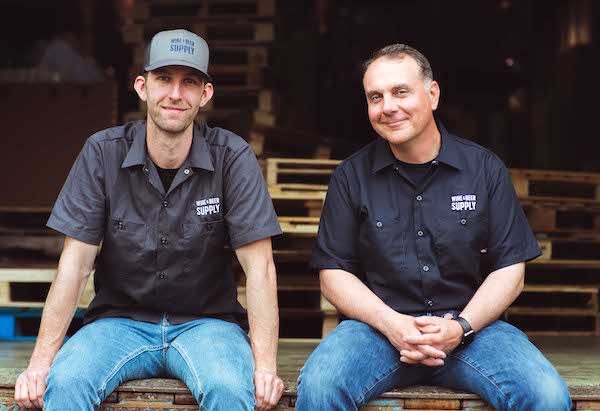
Ashland-based Wine & Beer Supply provides the bottles and cans for many local breweries and wineries. (BizSense file)
As breweries and wineries reopen and patrons raise glasses once again, a local company that supplies booze-holding cans, bottles and glassware has struck a deal to merge with a Garden State counterpart.
Ashland-based Wine & Beer Supply joined forces with Gino Pinto Inc., a decades-old supplier of winemaking equipment out of New Jersey.
Both firms will keep their respective names, with Gino Pinto’s Michael Pinto joining Wine & Beer Supply’s Casey Werderman and Dave Robertson as operating partners of the business.
Casey Werderman and Dave Robertson of Wine & Beer Supply.
Werderman said the two sides began discussing a deal before the pandemic.
“Both of us wanted to expand our reach into additional territories,” Werderman said. “For us, we were thinking, ‘Hey, do we want to greenfield a location in the Northeast?’ Because it’s important to our growth. But this was a much better way to go about doing it.”
Since its founding in 2015, Wine & Beer Supply has been providing cans, bottles and other glassware to breweries and wineries, as well as services like mobile packaging and warehousing. Last year it moved into a new headquarters at the Northlake Commerce Center, and over the years it has raised millions in investor capital.
The New Jersey-based firm Gino Pinto supplies wineries with bulk grapes and fruit juice from all over the globe, a service Wine & Beer Supply did not offer previously.
Gino Pinto, meanwhile, has been offering winemaking equipment, grapes, fruit juice, barrels and more since 1968. It serves both commercial wineries and home winemakers.
Werderman said the deal allows Gino Pinto and Wine & Beer Supply to fill in some gaps in service for one another.
“Our whole model is centered around consolidating the supply chain. Interestingly, there isn’t a whole lot of overlap between our organizations. The only overlap is around bottles. That’s it,” Werderman said.
Michael Pinto
“(Pinto) doesn’t do anything on the beer side. But he does a whole bunch of bulk grapes and bulk juice … and a bunch of winemaking equipment, which we don’t do any of.”
The deal closed June 1 and terms were not disclosed. Attorney Meredith Yoder of Parker, Pollard, Wilton & Peaden was Wine & Beer Supply’s counsel in the merger.
The two firms now operate more than 100,000 square feet of warehouse space in Ashland and Hammonton, New Jersey — Gino Pinto’s hometown about 35 miles southeast of Philadelphia.
Werderman said the firm has aggressive growth plans, which include additional locations relatively soon.
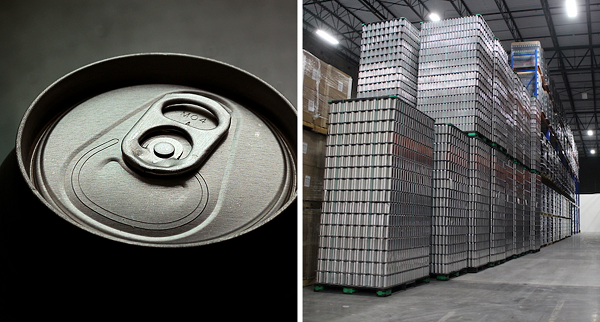
However, he said pandemic-induced supply chain issues such as can shortages continue.
“We’ve been fortunate to have strong manufacturing partners that we work with. It’s just really challenging,” he said. “People are coming back into the taprooms and that’s exciting. There is a shift back to kegs which is good to kind of offset some of the can shortages that are out there.”
Werderman said he thinks the craft beverage industry was able to weather the storm of the pandemic well.
“That’s the cool thing for me, looking at the industry as a whole and seeing that it’s resilient in some pretty strong ways,” Werderman said.
The two companies merged but will keep their respective names.
While the can shortages are a stressor for the industry, Werderman said he thinks a positive byproduct of online ordering for breweries and wineries is a new database of customers.
“Breweries and wineries have been able to generate more data in the last year than they have ever,” he said. “All of that critical information was just nonexistent. It has, in some ways, allowed them to come out of this even stronger.”
June 28, 2021 at 02:24PM
https://ift.tt/2UzpiuL
Wine & Beer Supply toasts to merger with New Jersey counterpart - RichmondBizSense
If your summer road trip takes you to New York’s Southern Tier, along the border with Pennsylvania, or to the Finger Lakes wine country, plan a stop in Corning, the city known for glassware and home of the vast collection in its Museum of Glass. Starting Saturday and running through the end of the year there’s a new exhibit that explores the connection between glass and wine, from ancient Rome to the present. A sealed bottle of wine from an 18th century shipwreck and an elaborate glass wine jug cut in a Russian pattern are among the objects on display.
“Fire and Vine: The Story of Glass and Wine,” July 3 through Dec. 31, 2022, $10 to $20 admission (children and teens under 17 admitted free); Corning Museum of Glass, 1 Museum Way, Corning, N.Y., 800-732-6845, cmog.org.
Chances are that last year you weren’t planning a July 4th gathering with friends in the back yard. So, with the pandemic mostly in the rearview mirror, let’s make this holiday one to remember. Fire up that grill or smoker.
There’s nothing like a rack of smoking ribs or a sizzling steak to provoke the palate. The aromatic smoke that wafts from a charcoal grill stimulates the appetite for the gaggle of friends or family who eagerly await the work of a master griller. Some grillers will be getting up early in the morning to smoke a brisket – a process that can take up to 14 hours – or pork butt. Others will be satisfied to grill hamburgers or fish after guests arrive. Whatever your choice, let’s not forget the wine.
Barbecued foods are generally well seasoned with rubs and slathers. Many times, there is a ketchup-based sauce on the side for fare like ribs and pulled pork. If that’s the case, you will want to marry the meat with a fruity wine, such as zinfandel or syrah. Zinfandel is an all-American grape variety and thus a perfect fit for Independence Day.
Zinfandel ranges in flavor profiles from the complex to the jammy. Expect to find these wines loaded with juicy dark fruit, but beware the high alcohol content that comes from very ripe grapes grown in the warm regions of California. Sharing a half bottle of zinfandel will impact you more than any other red wine.
If fish is your choice, then you have many options. If your preparation includes herbs, turn to sauvignon blanc or vermentino. These perky wines have good acidity with herbal and citrus character. A light red, such as pinot noir, works with salmon and tuna. Chardonnay is always a good fit if the fish has a cream sauce or is delicate.
We love to grill large portobellos – a great entrée for a vegetarian – doused in a reduce balsamic vinegar and topped with parmesan. Mushroom’s texture and flavor beg for pinot noir.
Burgers presents a wide range of possibilities: light Italian reds, Spanish tempranillo, merlot, malbec French Cotes-du-Rhone or other syrah/grenache blends. California blends work well here too.
Steak’s density and fat calls for cabernet sauvignon from your choice of regions. We love to pull out California cabernet sauvignon on this American holiday.
Here are some choices to consider:
7 Deadly Zinfandel 2018 (Vivino)
7 Deadly Zinfandel 2018 ($16). Both the 7 Deadly Zin and the 7 Deadly Cabernet Sauvignon are full-bodied and bold for serious grilled meat. We like the zinfandel for barbecued foods because its jammy berry character pairs well with sauces. There are lots of blackberry and spice notes herel.
Dutcher Crossing Brothers Reserve Dry Creek Valley Zinfandel 2017 ($40). Named for the brothers of winemaker Debra Mathy who she so reveres, this spirited zinfandel is a great match to grilled meat – ribs, burgers and even beef. Plum, raspberry and blackberry notes abound.
Attis Lias Finas Albarino Rias Baixas 2019 ($20). It seems that more Spanish albarinos are migrating from the biting citrusy acidity that used to dominate many examples that we tasted. We’re finding more albarinos from Rias Baixas are leaning to peach and pear notes and toned-down acidity which is more to our liking. This offering is a good example of this new style with peach and citrus notes as well as a creamy mid-palate.
District 7 Estate Grown Chardonnay 2018 ($18). Apple and pear notes dominate this oaky chardonnay from Monterey County.
Volver Tempranillo 2018 ($16). Made entirely from tempranillo grown on goblet-trained vines in a high-altitude single vineyard, this wine from La Mancha has licorice, blackberry, cassis and currant notes. Rich and tasty. It would be delicious with ribs, burgers and pulled pork.
Duckhorn Napa Valley Sauvignon Blanc 2020 (Oakville Grocery)
Duckhorn Napa Valley Sauvignon Blanc 2020 ($32). Exotic tropical and peach flavors follow a generous spread of pineapple and melon aromas. The 16 percent of semillon in the blend broadens the array of flavors and adds a smooth texture.
Amalaya Malbec Salta Argentina 2018 ($16). This has that classic rusticity that is associated with so many tasty malbecs from Argentina. Deep berry notes flavor and scent this value oriented red wine. Perfect for pairing with another Argentinian export — beef.
Colome Autentico Malbec Salta Argentina 2018 ($30). The Colome malbec has a riper smoother berry fruit expression and some licorice notes, and a bolder impression in the mouth. Although a bit more money it makes up the difference in price with elegance and complexity.
Blackbird Vineyard Napa Valley Arise Proprietary Red Wine 2017 ($40). We thoroughly enjoyed this plush, velvety blend of merlot, cabernet franc, cabernet sauvignon and petit verdot. Plum and cherry notes with a hint of mocha and tobacco. Long in the finish and just a pleasure to sip.
Other wine picks:
June 28, 2021 at 03:32AM
https://ift.tt/3x0QxN3
Wines To Pair With Whatever You BBQ - South Florida Reporter
So, you’ve procrastinated too long and think you’ve missed out on the popular SLO County Roll Out the Barrels (ROTB) annual wine tasting events in Edna Valley.
Imagine this, you still have a chance today to attend a great wine tasting experience or bid in the online auction for some excellent wines and lifestyle events. Now today (Sunday, June 27) is the last day for wine tasting rooms in the south county region of San Luis Obispo to celebrate ROTB, but most will be open for the standard wine tasting on Monday, June 28.
ROTB was formerly held at the Avila Beach Golf Resort with all of the wineries under tents, but that’s still on hold. Due to safety precautions the tastings are held strictly at the individual wineries, and most of them require a reservation. That ensures a smaller group of people to serve, with no crowding. That said, you can still call today and see if you can snag an opening because someone was forced to cancel. Isn’t that worth a simple phone call, which is easy to find thanks to the world wide web!
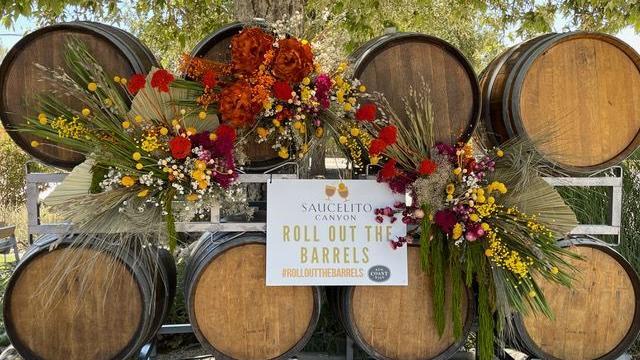
Among them will be the terrific Saucelito Canyon winery in Edna Valley, just a half-mile off Hwy. 227 (Broad Street), renowned for their excellent zinfandels and other top notch varieties.
They rank among SLO County’s historic pioneers in Central Coast wine country. Saucelito Canyon invites you to enjoy a great photo op, as pictured here, framed by their “Idlewood dried floral barrel wall.”
They will also feature musician Jill Knight for your enjoyment on Sunday. They open Sunday for the featured reserve wine tasting or standard tasting, and standard tasting only on Monday. It’s well worth calling to make sure you can get a reservation. Although they will be busy, sometimes they can accommodate walk-ins.
These days, locals are so happy to be free to visit inside or outside again, local wineries and restaurants are very busy. Along with the vintners, we are all quite grateful for that. Every wine tasting room I visit lately, no matter what day of the week or time, is packed with joyous wine lovers.
Another generous winery glad to accept walk-ins is Filipponi Ranch in San Luis Obispo, just off Los Osos Valley Road, near Hwy. 101. On Sunday, they will feature live music from 1 until 4 p.m. Their line-up of wines will include the new release of 2019 Edna Valley chardonnay, and a 2018 Edna Valley grenache, plus barrel samples to preview. The tasting fee is $15 per person and “walk-ins are welcome.”
Another favorite in Edna Valley is Claiborne and Churchill, located on Hwy. 227. And with all of their enticing treats to enjoy in their soothing garden patio, it’s a win-win. For ROTB they are offering a delicious wine country brunch in the garden patio. They will complement the delightful late breakfast with a house flight of their aromatic white wines, dry rose, and their pinot noirs and Rhone reds varieties.
Or you can choose an all white wine or red wine flight. You will receive full table side service and live music by Chris Beland. It’s a 90-minute wine and food lover’s experience but reservations are required. Now I can’t promise you can get in today, but isn’t it worth a phone call (there are always last minute cancellations). I know for a fact they will do their best to accommodate you if they can.
This event only takes place from 11 a.m. until 2 p.m. If you can’t make it today, you can visit any time as they are open daily from noon until 5 p.m. Do check our their website for special weekly events like “happy hour Friday.”
New at Sinor-LaVallee in Avila Beach is the Morro Bay Oyster Co.’s oyster shucking experience. You can have their Pacific Golds paired with pick five out of the eight wines produced by Sinor-LaVallee, or a white or a red flight, and you’ll enjoy a treat only found on the Central Coast.
The wine tasting room can also provide an oyster knife and glove to protect your hand, that you can purchase. This is not just a ROTB special, they have earned a license so they can provide this oyster and wine pairing nearly every day. The key is ordering the bivalves online in advance of your visit, and you’re guaranteed your dozen oysters.
Vintner and winemaker Mike Sinor told me they’re calling it the “the shuck shack at Sinor-LaVallee,” and the freshly caught oysters are very fairly priced $25 a dozen to the public, and only $20 per dozen for wine club members.
I love this idea, and Sinor’s prices are far more reasonable than the average oyster price in restaurants. The pandemic is finally fading out, and thanks to our creative vintners who struggled to survive it, they are coming up with some fantastic ideas for their tasting rooms!
Bon appetit!
June 28, 2021
https://ift.tt/3zXZXep
Kathy Marcks Hardesty: Spring flings offer good times in wine country - Santa Ynez Valley News
Christine PersaudPublished 12:46 p.m. ET June 27, 2021
— Recommendations are independently chosen by Reviewed’s editors. Purchases you make through our links may earn us a commission.
Looking to stock the wine cabinet before your Fourth of July gathering? There's never been a better time to do it: Winc, the famous wine club, is celebrating early with a special sale for first-time customers,
Get expert shopping advice delivered to your phone. Sign up for text message alerts from the deal-hunting nerds at Reviewed.
The company is currently offering four bottles for $24.95, which is down $5 from the regular price of $29.95. Better yet, you'll also get free shipping. From cabernet and pinot noir to pinot grigio, chardonnay and more, there's a wine type here to cater to every taste—and with this offer, you'll be getting each bottle for roughly $6.23!
You can use this discount to check out some of the site's newest arrivals, like So This Happened, a 2020 rosé from California with notes of honey, raspberry, red cherry and strawberry. Previous buyers gave it a solid 4.2-star rating. It normally retails for $14.99 ($12.99 for Winc members), saving you $8.76 from the list price.
Prefer reds? Check out the 2020 Sister Snake cabernet sauvignon from Western Cape, South Africa, a full-bodied, silky wine with a dark fruit taste that past drinkers awarded 4.1 stars. It also has a list price of $14.99 and member price of $12.99 as well, meaning you can get this one for the same more-than-50% discount.
So how does a Winc subscription work? It's pretty simple: The site prompts you to take a fun quiz to figure out which wine blends will best suit your palate. The site will make suggestions based on your answers, or you can pick you own—in either case, you can choose the bottles you like and how many (there's a minimum of three) to be delivered to your home each month. Credits you don't use can be rolled over, too.
We loved the service for its user-friendly website, as well as the rotating selection of unique-to-Winc wines that keeps it fresh. (Winc produces its own bottles and partners with independent growers and winemakers to create them.) Our executive editor of commerce, Kate Ellsworth, found herself becoming "obsessed" after she tried the service: Her first set of four wines as chosen by Winc were all on point—including the red varietal that Kate didn't think she'd like. She also loved the sliding scale of flavors she received with each bottle, allowing her to mark down which tastes she tended to prefer over others for future reference.
If you love wine and trying new wines, this is a deal you won't want to miss. Find your new summer favorites now!
Need help finding products? Sign up for our weekly newsletter. It’s free and you can unsubscribe at any time.
The product experts at Reviewed have all your shopping needs covered. Follow Reviewed on Facebook, Twitter, and Instagram for the latest deals, reviews, and more.
Prices were accurate at the time this article was published but may change over time.
Read or Share this story: https://ift.tt/3jjfwrd
June 27, 2021 at 11:47PM
https://ift.tt/3jjfwrd
We're obsessed with the Winc wine subscription service—and you can get it for a special price - USA TODAY