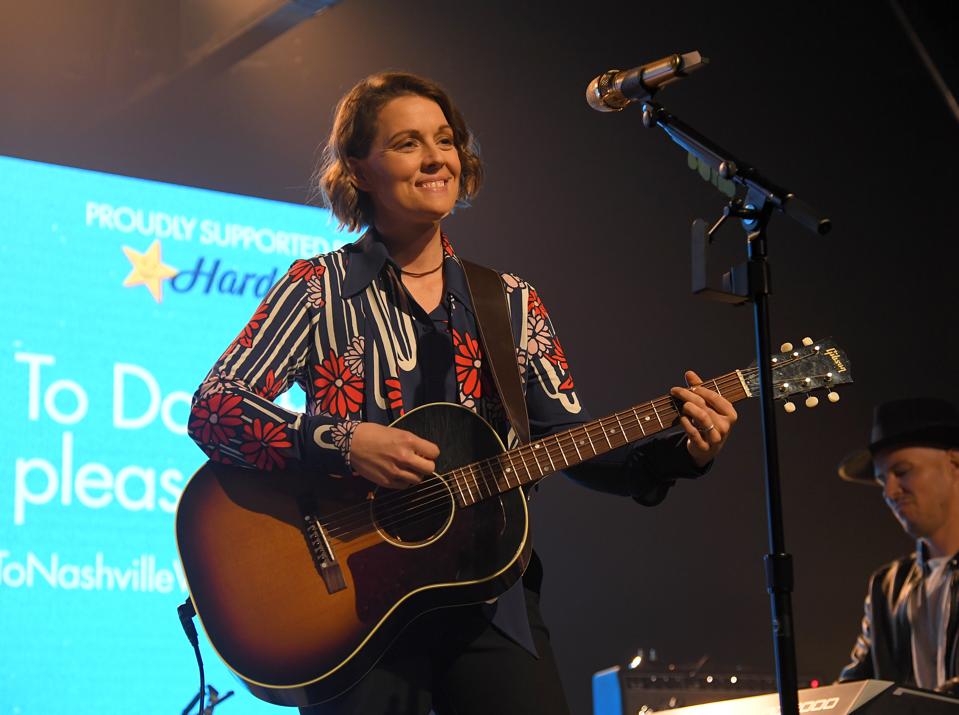
NASHVILLE, TENNESSEE - MARCH 09: Brandi Carlile performs during To Nashville, With Love A Concert ... [+]
Getty ImagesGrammy-winning singer/songwriter Brandi Carlile has joined the long list of celebrities, including Dave Matthews, Maynard James Keenan, Kylie Minogue and Sting, who have their own wine.
Like everything Carlile does, the XOBC Cellars she started with her wife Catherine and friends, Amy and Jeri Andrews, is infused with the spirit of activism and inclusion.
Ask Carlile, whose XOBC Cellars just launched their latest wine, their first sparkling rose, what her dream for the company is and the answer is not surprising for anybody who has followed Carlile's trajectory to superstardom.
"I've learned how abysmally un-diverse the wine-making industry is. There are very few, if any, LGBTQ completely own and run cellars, very few women or people of color in that industry at all," she says. "I'd like to see something come of that. I'd like to see a light being shone on diversity in winemaking because I think diversity in wine is symbolic and beautiful."
Carlile will be celebrating the launch this Thursday, October 29, at 6 PM EST/ 3 PM PST as part of Live Nation's Happy Hour: Women In Wine where Carlile and XOBC partners and other female winemakers will join a panel discussion moderated by Live Nation Women's Nation president Ali Harnell.
While XOBC Cellars was the impetus for our recent conversation, the talk inevitably turned to music and activism as it always does with Carlile. In our fascinating and thoroughly enjoyable chat we covered everything from Dolly Parton and Elton John to how her family life has changed during Covid and why she doesn't believe touring will ever be the same.
Steve Baltin: Take me through the winemaking process. How involved are you?
Brandi Carlile: I didn't stomp any grapes (laughs). But I went out to Walla Walla and spent time with the winemakers and pulled some things out of beakers and opened up some barrels and we tried things and we talked about stuff. And on my list of things that were important to me, all of those things were covered in what we ended up with all of our wines. But I wouldn't say I am hands on in the wine-making process, even if they allowed me to think I was (laughs).
Baltin: How far back does the XOBC Cellar go?
Carlile: This is only about a couple of years in the making. It's another extension of my activism with my wife and my friends. We were trying to find ways to support the causes that we believed in, particularly during this time when the conception of XOBC Cellars came about. That's why displaced peoples, refugees, asylum seekers, economic immigrants, migrants, they really all feel the same to me in terms of just people needing to change their situation desperately. And we were doing house parties, house concerts with Amy and Jeri Andrews, the couple that we got into this wine-making endeavor with. And we would throw little parties at their house and people would pay to come. Then we would take all that money and support War Child and Children In Conflict. And there was a place out in Walla Walla and they were really big fans of this winemaker and of this region, the Rocks, in particular. and that's how it came about. Been about two years in the making. It's been really more satisfying that I would have even anticipated.
Baltin: Have you always been a Xenophile?
Carlile: You know, I wanna say that it was just that came about our togetherness and desire to contribute. When I think of wine I think of joy and people coming together over a table, whether it's a literal table or a figurative table and sort of sharing something. And I thought that would resonate and it did. And I also wanted to have a wine drink that wouldn't give me a f**king headache in the morning (laughs). Really hard thing to find so we got to talking about that combination, XOBC Cellars.
Baltin: Are there people you admire for the way they've mixed philanthropy and business?
Carlile: What you're saying, 100 percent. That has been the cornerstone of my musical career when it started. To be honest with you, first things first, I fell in love with Elton John over a fifth grade book report and ever since then I have always seen music and activism as inextricably linked. My favorite artists are activists. And in fact if an artist isn't an activist I find myself having a really hard time connecting to their music. I don't mean to sound stringent, but when I was 12 years old learning about the Elton John AIDS Foundation, Neil Young and Bridge School and Annie Lennox and her global philanthropy and Willie Nelson and Farm Aid, all of these artists, my heroes, my beacons, are all connected to, and not in a small way, making the world a better place or trying to make the world a better place. There's a humility about artists when they do it that I really appreciate.
Baltin: There are a lot of great artists and foundations as you mention. But it's interesting to tie it in with a business like wine. So are there other models you looked at as inspiration for XOBC Cellars?
Carlile: To be honest, whenever I stumble into a business situation it's accidentally. It all starts with intention and a lot of people around me that like beautiful things, but life planned it and to plant beauty into the world. So when we start working on anything within our foundation, XOBC not excluded, there's going to be an element of aesthetic and social responsibility and potential profitability that are going to be discussed. And those details are going to be pored over usually. But I really appreciate it when business finds its way into great activism and when great activism finds its way into great art. I think it's a completion of a circle.
Baltin: What is the playlist that goes with the sparkling rose?
Carlile: Oh, I love it. I'm gonna say, Dolly Parton, "Eagle When She Flies," I'm going throw out the Highwomen, "Crowded Table," Gregory Allan Isakov, "Dandelion Wine" and my final pick is gonna be Courtney Marie Andrews "If I Told."
Baltin: So why those songs?
Carlile: Yeah, because "Eagle When She Flies" has the lyric and the melody in that song and Gregory Allan Isakov's "Dandelion Wine" paints a picture and wine does the same thing. Courtney Marie Andrews' "If I Told" is deeply romantic and thought provoking "Crowded Table," by the Highwomen, brings people together.
Baltin: And when it comes to mixing philanthropy, business and music I would say Dolly is on the Mount Rushmore of that.
Carlile: The queen herself! And when she does it it's in these big, sweeping, unpretentious ways. She responds. The world shifts, reacts and Dolly responds. And she always responds with something that can help real people in a real people, not just people with means or people with access to high levels of education and power, but real people. She puts books in the hands of children and rebuilds people's houses, tangible things that you can take home with you.
Baltin: You've gotten to be around Dolly and Elton, cause he was at your Disney Hall performance of Joni Mitchell Blue, which after I got to meet Joni you are one of my heroes cause there is something so big about her presence. So to do that album in front of her, wow!
Carlile: (Laughs) Yeah, that took some solid brass ball. I don't even know how I got through it when I think about it. I was a different person a year ago (laughs).
Baltin: But back to being around Elton and Dolly, as you have gotten more success over the last few years and your reach has increased, are there people you reached out to or watched to see how to maximize that reach for good?
Carlile: One of the things I've always known about my activism is its limits. So I don't have the tenacity that say Elton or Willie will have in terms of spending 20 or 30 years on the same cause. I do my most honest work in the midst of everything; I'm a campaign-based activist. So I will get really passionate, really emotional about something and do my absolute best work for around a year or two years. And then something else will make me really passionate. That's the status of humanity right now. One day it's the refugee crisis, but that doesn't go away when climate change takes center stage or when we find ourselves in the midst of a global pandemic. And then I would start another campaign, while not abandoning the last one. So the Looking Out Foundation, from the beginning, has always been this impassioned campaign-based foundation. And I've always felt it's really grassroots and really honest. It's something I'm super proud of. So this is how we understand and cope with our privilege. We understand that when you are given a platform, you didn't get it on your own; that when you are given means, you did not generate those means on your own, and the cliche of giving back is a cliche for a reason. It's absolutely imperative. No one believes you if you don't know how to do it and no one should believe you if you don't know how to do it.
Baltin: What is the dream wine for XOBC Cellars to do next?
Carlile: I'd like to see, at least our involvement of wine, reflect a different kind of intention and maybe speak to a different kind of person. Wine has a tendency to be associated with a discerning, kind of highbrow consumer. But I would like to see it shared amongst people that value togetherness and value diversity.
Baltin: How is music coming for you during this time? Most every artist I have spoken to has found some sense of creative freedom by not following a cycle?
Carlile: Yeah, totally, I feel like I've broken out of a box. Some of the things that I've done in this moment have been like the most satisfying things of my career, like singing with Soundgarden. Really huge and that put me straight back, feet on the ground in the streets of Seattle and just making me really remember when I came from. And the collaborations have been my favorite part about this time, the way that we talk with an artist and we really spend time talking to one another outside of any construct. It's new and it reminds me of being backstage at some festival overseas where everybody's been away from home enough where they just want friends. It's led to some pretty cool collaborations and connections. But the final thing that has brought me the most creative freedom is really learning how to live and in my family all the time. We've always traveled together, but it's a different thing when you're on the road together and you're working, it's a grind. But being in this house everyday and really being privy to every single second of my children, I don't think I'll ever be the same and I don't think I'll ever go back to being the same.
Baltin: I have spoken with so many artists who say the same thing. And everyone sees things now in a different light.
Carlile: Oh yeah, nothing's going back to the way it was, for better or for worse. I think everything was fine the way it was before, but especially live music and live touring, was heading in a really homogenous direction. The places we were playing, the way we were playing them and everybody suddenly really caring about the clubs we came up in and the theaters, the community theaters and the union halls and their survival and how we can keep touring alive outside of the kind of sterile and corporate construct. And I'm here for that s**t.
Baltin: But as you get bigger it gets harder to play those spaces. For me, my favorite space in L.A. is the Troubadour because of the history. But it's not realistic for you to come in and play a solid month there.
Carlile: Maybe I will now and that's what I mean. Things have changed. When this s**t hits, one minute you're talking about the Target Center and then the next minute you're really worried about the 9:30 Club. I'm not worried about the Target Center. I'm worried about the 9:30 Club, worried about Cat's Cradle and the Troubadour and the Fillmore and these places that made us who we are. And also it's the places that young art desperately need to thrive and survive. When this culture and industry comes back, touring, I think you're gonna have really big artists playing those places, which is gonna be really cool for fans. But it's really important to nurture and keep the door open for the younger generation of artistic innovators, because that's the future of our art.
Baltin: Are there songs for you that are the symbol of your activism?
Carlile: Yeah, absolutely. I'm gonna give you another five songs. I would say "Hallelujah," by Leonard Cohen; "I Will Always Love You," Dolly Parton; "Someone Saved My Life Tonight," Elton John; "Murdered In The City," the Avett Brothers, and "Little Green," by Joni Mitchell. So when you lay those out, to me, they feel more like really deeply emotional songs that ignite in me that insurmountable kind of passion. And I don't know how it pertains literally to my activism. But it's triggered in that place. That's where it comes from for me.
October 25, 2020 at 08:00PM
https://ift.tt/3ktA3qI
Sunday Conversation: Brandi Carlile On Wine, Dolly, Elton, Family And How Touring Is Forever Changed - Forbes
https://ift.tt/31lUVcw
Wine



No comments:
Post a Comment